
When the nordic community builder Peab, together with us at Icons Of, decided to take a deeper look at their Scope 3 emissions, the challenge was very concrete: thousands of accounts, large volumes of transactions and the need to produce numbers that are both trustworthy and genuinely useful for the business.
We at Icons Of introduced AI – not as a standalone tool, but as a way to strengthen and scale the expert work already being done.
AI + experts = the right combination
This project would never have worked if AI had been left to operate on its own. You need people who understand their operations, supply chains and emissions. That is why the approach is built on human in the loop.
Together with LCA consulting firm Miljögiraff, we worked closely with Peab’s own domain experts, who manually classified an initial set of accounts. That became the training data for the AI model, which then learned - over a few iterations - to recognise the patterns and could propose classifications for the rest.
This collaborative workflow also helps avoid misunderstandings. One example we have laughed about together is purchases from the working clothing company Björnkläder (a name that literally translates to “Bear clothing”) – which, in an early training phase, the AI attempted to interpret as fur products. With human feedback, mistakes like that are quickly corrected.
This is how trust is built: the AI handles the heavy lifting, and the experts ensure the results are accurate.

E45 Sankning Goteborg Natt, Peab pressbilder, Photo: Markus Esselmark
A more complete Scope 3 – without drowning in details
When you work with many thousands of transactions, two things are needed at the same time:
1. Understanding what actually matters
The AI identifies the major sources of emissions. This provides a clear overview of where the largest climate gains can be made, and where proxy emission factors are sufficient without losing direction.
2. Capturing all the small things
The smaller purchases are often too numerous to handle manually, yet together they can be meaningful. Here the AI helps match them with relevant emission factors. The result is a Scope 3 picture that is fully comprehensive, without anyone having to classify every single line item.
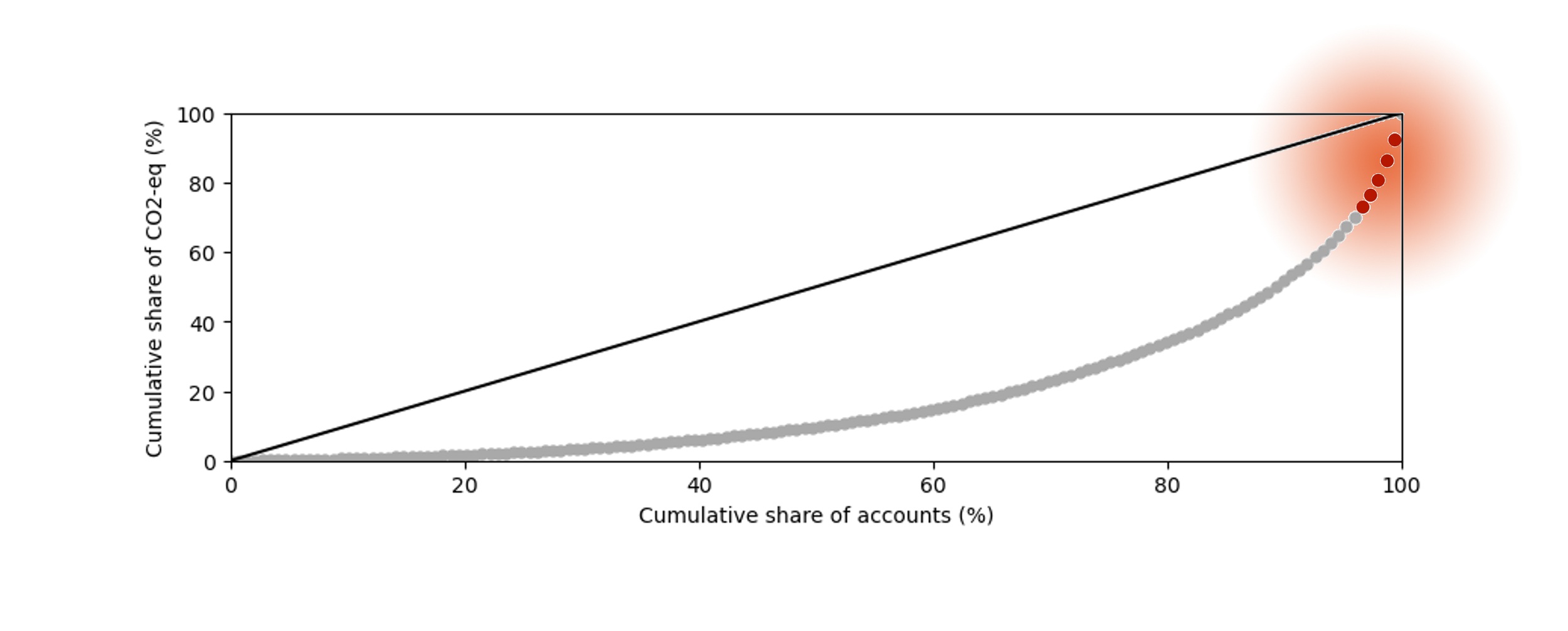
Lorentz curve illustrating cumulative share of carbon emissions. A dot represents an account. Top 5 accounts (3%) contribute to 24% of total emissions.
Our technical approach – making large‑scale classification possible
While the overall story of the project is about combining expertise and AI, the technical approach behind it is worth highlighting. It is this foundation that makes it possible to analyse thousands of accounts and transactions in a way that is both repeatable and auditable.
Using expert‑validated training data as the backbone
We began by collecting a small random sample of accounts that Miljögiraff and Peab’s experts classified manually. These classifications form the "ground truth" that the model learns from. The goal was not only accuracy, but clarity: every label is, in fact a spend-based emission factor, tied to a clear rationale grounded in LCA practice.
Fine‑tuning a language model for domain‑specific understanding
We then fine‑tuned a language model to understand Peab’s purchase descriptions, supplier names and accounting structures. This is crucial, because enterprise data can be noisy, shorthand‑heavy and full of internal terminology. The model is trained to interpret:
supplier names and context
account names
company profiles
the relationship to the given set of emission factors
This enables the AI to propose classifications that align with the structure of Exiobase (as well as other emission factor datasets).
Iterative human‑in‑the‑loop refinement
To ensure the model learns in a controlled and verifiable way, we use a structured sampling and review process which is the method we developed and use in the project:
Weighted sampling: we draw a small sample of accounts (e.g. 20) that have not yet been manually reviewed. The chance of an account being selected is proportional to its estimated CO₂ impact.
Manual assessment: the sampled accounts are manually classified by experts (Miljögiraff and Peab).
Comparison with the model’s output: each expert judgement is compared with the classification generated by the model.
Adding new training data: the newly assessed accounts are added to the training dataset.
Updating the model: the model is refined using this expanded dataset.
Measuring improvement: we evaluate how much the updated model differs from the previous version.
This cycle is repeated until the difference between two iterations falls below a reasonable and agreed threshold. It ensures that AI and expert knowledge converge, and that the model only becomes more reliable with each step.
Built for transparency and auditability
Instead of training once and declaring it done, we set up an iterative cycle:
model proposes classifications,
experts review and correct them,
corrections feed back into the training data.
This is how the model becomes more reliable over time – and why it remains aligned with domain knowledge rather than drifting into guesswork.
Built for transparency and auditability
From the very beginning, Peab had a clear requirement: the method needed to be reliable enough to withstand external review. Together with Miljögiraff, we therefore designed the process so that every step – from the first manual classifications to the final result – can be traced and understood.
The AI model is trained and refined iteratively. This is what creates confidence that the model is doing the right thing, not just producing attractive numbers.
Because the same logic can be applied year after year to new data, the approach also supports consistency over time. Changes in purchases are reflected in updated classifications and results, making trends visible without having to rebuild the method each time. Peab ends up with their own very specialised AI resource.
Where we are heading – more AI, more real data, better decision‑making
For the largest emission sources, proxy factors are not enough, no matter how refined they are. More detailed data from actual suppliers is needed, year by year. Only then can companies set meaningful KPIs, follow up and drive real change.
This is where initiatives as e.g. MASSIV+ comes in as the next step. It is about using AI to make data sharing and data quality possible on a larger scale – so that proxy factors can gradually be replaced with real figures where it matters most.
We see AI as the link that makes all of this possible: the holistic view, the prioritisation, the quality and the flow of data throughout the entire value chain.
And equally important: AI is only ever as good as the people who train it. This project shows how powerful the combination becomes when both work together.
Do not hesitate to get in contact with us at info@iconsof.se
(Read also Miljögiraff blog: PEAB tar sig an Scope 3 – med hjälp av AI)